
Pseudomonas Agar Base
KM0079
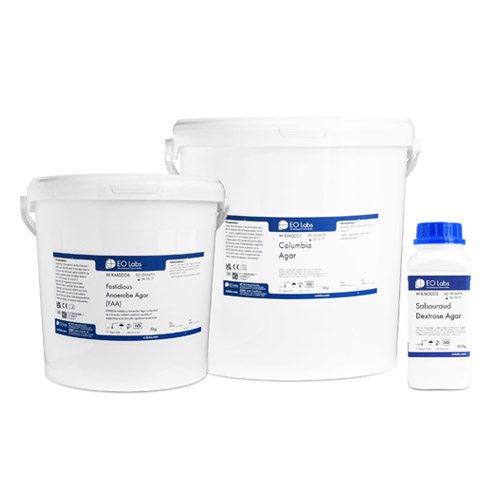
Dehydrated Culture Media products are formulated to supply the required nutrients to allow for the growth of microorganisms.
Used in combination with a variety of selective agents and incubation conditions a wide range of specific organisms can be isolated.
With careful raw material selection of the various media components E&O can ensure a consistent level of quality and performance.
For each formulation the necessary ingredients are accurately weighed, combined and blended together to produce a homogenous powdered product.
Product Enquiry
Pseudomonas Agar Base
KM0079
Pseudomonas Agar Base with the addition of supplements, is a selective medium for the isolation of Pseudomonas species primarily from clinical, food, water, and environmental samples.
The medium can be made selective for Pseudomonas aeruginosa by the addition of E&O LS0006 Pseudomonas Selective Cetrimide and Nalidixic Acid Supplement which complies to ISO 16266:2006 and ISO 11133:2014. Alternatively, the medium can be made selective for Pseudomonas species by the addition of E&O LS0026 Pseudomonas CFC Selective Supplement which complies to ISO 13720:2010 and can be used as a primary isolation medium according to Public Health England’s UK Standards for Microbiology Investigations.
Identification is achieved using the unique ability of P. aeruginosa to synthesise the iron chelating pigments pyoverdin and pyocyanin which combine to produce the characteristic green colonies of Pseudomonas aeruginosa. Production of these pigments is stimulated by the presence of magnesium and potassium ions in the medium. The presence of blue/green or brown pigmentation or fluorescence is indicative of presumptive Pseudomonas species. It should be noted however that further testing must be conducted to confirm the full identity of the organism.
Enquire About Product
Shelf Life
1095 days
Storage Temperature
10–30°C
pH
7.1 ± 0.2
Appearance
Firm Gel
Colour
Clear Agar
Detailed performance specifications and Quality Control testing protocols are available in the IFU located in the supporting documentation section
Standard formats are listed below. For non-standard requirements or bespoke fill volumes, please submit a technical enquiry.
Fill Volume
Pack Size
SKU
Request Quotation
10kg
1 x tub
KM0079-10KG-10000
500g
1 x tub
KM0079-500G-500
5kg
1 x tub
KM0079-5KG-5000
Shelf Life
1095 days
Storage Temperature
10–30°C
pH
7.1 ± 0.2
Appearance
Firm Gel
Colour
Clear Agar
Detailed performance specifications and Quality Control testing protocols are available in the IFU located in the supporting documentation section
Standard formats are listed below. For non-standard requirements or bespoke fill volumes, please submit a technical enquiry.
Fill Volume
10kg
500g
5kg
Container
10KG tub
500G tub
5KG tub
Pack Size
1 x tub
1 x tub
1 x tub
SKU
KM0079-10KG-10000
KM0079-500G-500
KM0079-5KG-5000
Batch QC results for this product can be obtained from your customer portal, please use the link below to access this.
Support