
Burkholderia cepacia Agar
KM0076
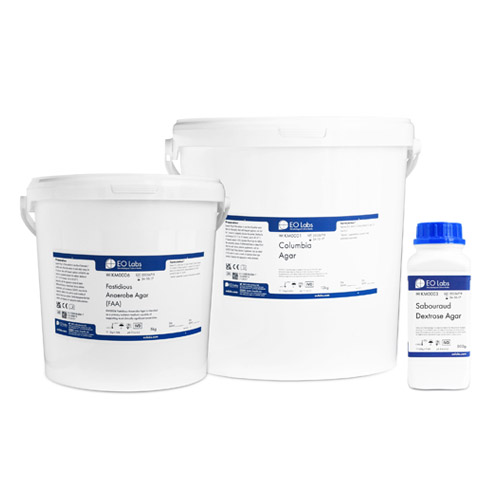
Dehydrated Culture Media products are formulated to supply the required nutrients to allow for the growth of microorganisms.
Used in combination with a variety of selective agents and incubation conditions a wide range of specific organisms can be isolated.
With careful raw material selection of the various media components E&O can ensure a consistent level of quality and performance.
For each formulation the necessary ingredients are accurately weighed, combined and blended together to produce a homogenous powdered product.
Product Enquiry
Burkholderia cepacia Agar
KM0076
Burkholderia cepacia agar base is a selective medium for the detection and isolation of Burkholderia cepacia from cystic fibrosis (CF) patients. This is an important opportunistic pathogen in CF patients and can lead to fatal infection in approximately 20% individuals that have been colonised with B. cepacia complex organisms. This medium is based on the PC medium described by Gilligan et al.
Magnesium sulphate, ammonium sulphate and ferrous ammonium sulphate supports the growth of B. cepacia. Potassium di-hydrogen phosphate and di-sodium hydrogen phosphate are buffering agents, used to maintain the pH the medium. The phenol red is used as a pH indicator. If the sodium pyruvate in the medium is metabolised by B. cepacia alkaline by-products are produced which raises the pH. This causes the colour of the medium to turn pink/red around sections of heavy growth on the medium. Bile salts and crystal violet are selective agents.
The associated selective supplement for this medium, LS0125, contains ticarcillin and polymyxin B which further improves the selectivity, particularly with the inhibition of Pseudomonas spp.
Related Supplements :
LS0125 B.cepacia Selective Supplement, LS0026 Pseudomonas CFC Selective Supplement
Enquire About Product
Shelf Life
1095 days
Storage Temperature
10–30°C
pH
6.2 ± 0.2
Appearance
Fine Powder
Colour
Beige
Detailed performance specifications and Quality Control testing protocols are available in the IFU located in the supporting documentation section
Standard formats are listed below. For non-standard requirements or bespoke fill volumes, please submit a technical enquiry.
Fill Volume
Container
Pack Size
SKU
10kg
10KG tub
1 x tub
KM0076-10KG-10000
500g
500G tub
1 x tub
KM0076-500G-500
5kg
5KG tub
1 x tub
KM0076-5KG-5000
Batch QC results for this product can be obtained from your customer portal, please use the link below to access this.
Support
Shelf Life
1095 days
Storage Temperature
10–30°C
pH
6.2 ± 0.2
Appearance
Fine Powder
Colour
Beige
Detailed performance specifications and Quality Control testing protocols are available in the IFU located in the supporting documentation section
Standard formats are listed below. For non-standard requirements or bespoke fill volumes, please submit a technical enquiry.
Fill Volume
10kg
500g
5kg
Container
10KG tub
500G tub
5KG tub
Pack Size
1 x tub
1 x tub
1 x tub
SKU
KM0076-10KG-10000
KM0076-500G-500
KM0076-5KG-5000
Batch QC results for this product can be obtained from your customer portal, please use the link below to access this.
Support
